
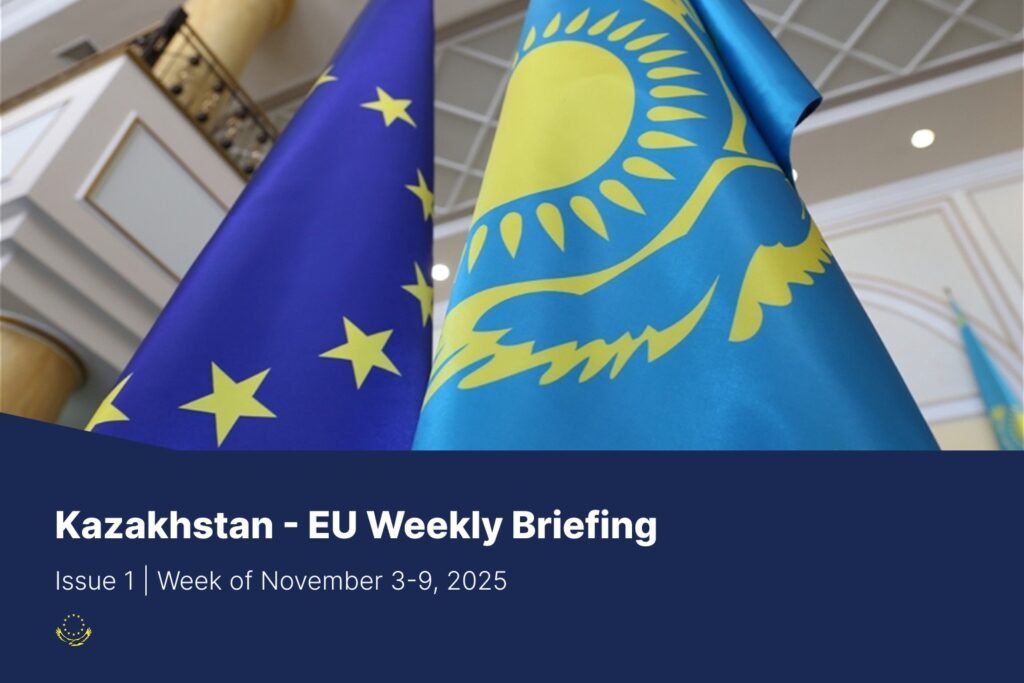
Kazakhstan-EU Weekly Briefing Issue 1: Week of November 3-9, 2025
I. EU-Centric Trends: What Brussels is Watching
- The “Digital Bridge”: EU Eyes Kazakhstan as a Key Data Hub to Asia
– Key Development: Discussions among European policymakers have intensified, zeroing in on Kazakhstan’s strategic importance as a central hub for digital infrastructure designed to connect Europe and Asia. (Source: Euractiv)
– Trend Analysis: The EU is increasingly looking to Kazakhstan as a primary partner for digital connectivity. This marks a clear strategic shift: policymakers are beginning to see the country not just as an energy supplier, but as a “digital bridge” to Asia. This strategy involves fostering secure data corridors and reliable digital trade routes, with Kazakhstan at the center.
– Why it Matters: This move positions Kazakhstan as a key player in the EU’s flagship “Global Gateway” initiative, diversifying the relationship beyond energy. It aligns geopolitical goals with clear economic opportunities in the high-growth data market. What to Watch: Look for specific EU investment announcements targeting trans-Caspian digital infrastructure and any new rules to harmonize digital trade. - Skills and Prosperity: EU Renews High-Level Partnership with Central Asia
– Key Development: The European Union recently reaffirmed its high-level policy to strengthen cooperation with Central Asia, identifying “skills and shared prosperity” as key pillars for future investment. (Source: EEAS)
– Trend Analysis: This policy signals a strategic decision to invest in people, education, and long-term economic development. The EU aims to build regional resilience and foster a shared economic future, adding a new layer to existing cooperation in energy and security.
– Why it Matters: This focus on human capital is the EU’s long-term strategy for fostering regional stability. It aims to align the Central Asian workforce with EU standards, creating a more predictable and integrated economic partner. What to Watch: Monitor for new EU-funded educational programs (like an enhanced Erasmus+) and any new initiatives focused on digital skills or vocational training in the region.
II. Kazakhstan-Centric Trends: Developments on the Ground
- Kazakhstan Moves Forward on Digital Trade Integration
– Key Development: With support from the EU and the International Trade Centre (ITC), Kazakhstan has begun implementing the CARTIS system, an analysis tool to assess and harmonize its digital trade standards. (Source: EEAS)
– Trend Analysis: In step with the EU’s strategic goals, Kazakhstan is taking concrete measures to link its digital trade framework with the EU. This move shows a clear domestic commitment to adopting common standards, a practical step that directly supports the “digital bridge” concept and promises to simplify and speed up trade.
– Why it Matters: This proactive, on-the-ground implementation of digital tools turns the “digital bridge” idea from high-level rhetoric into practical reality. It demonstrates Kazakhstan’s credibility as a partner that can get things done. What to Watch: Track the rollout of the CARTIS system and any reports from the ITC or exporters on faster customs processing and more efficient trade. - Agriculture Sector Hits Record Growth, Signals Untapped Potential
– Key Development: Recent government and industry reports confirmed that Kazakhstan’s agricultural sector achieved record growth in 2025. This was paired with a 4.7% rise in grain exports, highlighting significant untapped market potential. (Source: Astana Times; Qazinform)
– Trend Analysis: Kazakhstan is showing significant growth in its non-energy economy, underscoring a key trend of diversification. For the EU, this signals Kazakhstan’s growing capacity as a reliable partner for food security and a source of high-potential market opportunities outside the raw materials sector.
– Why it Matters: This diversification strengthens Kazakhstan’s economic foundation. For the EU, it presents a timely opportunity to secure alternative food supply chains—a key priority for the bloc – and engage with a high-growth, non-extractive market. What to Watch: Keep an eye on agricultural export figures and any new bilateral talks aimed at harmonizing food safety (SPS) standards, which would open the EU market further.